Why We Need to Hang Up On Our Distracted Driving Addiction
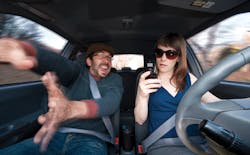
But the question remains: When are we truly going to kick our distracted driving habit to the curb?
David Strayer, Ph.D., director of the University of Utah's Applied Cognition Lab, has been at the forefront of distracted driving research over the last decade. According to Strayer, most people who use cell phones while driving think they can get away with it. And they can — for a time.
“You don't instantly crash on the road while talking on the cell phone. And you don't instantly crash when you're drunk, either,” Strayer says. “In the long run, if you do it enough, you're going to put yourself at risk.”
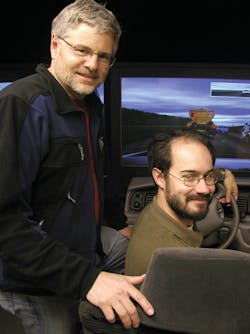
That's right — Strayer compares using a cell phone behind the wheel to drunk driving. And he has the research to back it up. The university's Applied Cognition Lab uses a driving simulator — complete with a steering wheel, dashboard displays, gas/brake pedals and screens that show a driving environment — to test driver reaction and behavior in a safe, controlled environment.
“We directly compared drunk drivers and cell phone drivers and found that cell phones were every bit as bad, if not worse, as drunk driving,” Strayer explains.
According to the 2006 study, cell phone users are as impaired as drivers intoxicated at the legal blood-alcohol limit of 0.08 percent. Cell phone users drove slower, were 9 percent slower to hit the brakes, displayed 24 percent more variation in following distance, were 19 percent slower to resume normal speed after braking and were more likely to crash.
“The National Safety Council suggests that 1 in 4 crashes on the highway now involve cell phone use in one way or another — dialing or talking or texting,” Strayer points out. “There are 40,000 fatalities [annually], so if those numbers are right, we're losing 10,000 people every year from cell phone-related crashes. That's a lot. If we had that same kind of fatality rate with any kind of pharmaceutical, we would pull those drugs off the market in a heartbeat.”
Why We Do It
Part of the reason cell phone use is so prevalent on the road is that we all seem to think we're superior drivers.
“We have a tendency to overrate our own abilities,” Strayer explains. “We think we're better-than-average drivers and we think we're better-than-average multitaskers.”
According to Strayer, most people would agree they have seen a driver's ability become impaired while using a cell phone. But if you ask, “Have you been impaired while driving and having a cell phone conversation?” the answer changes because people are less likely to notice their own dangerous behavior. Strayer says this combination of “delusion and inattention” is making our highways less safe.
Arthur Liggio, executive vice president at Driving Dynamics, a provider of safe driver training for corporate fleet drivers, says the problem is growing.
“As more and more of the adult population have really signed on to using cell phones, it permeates our entire society,” Liggio says. “What was once perhaps a minor issue, because only a small percentage of our population was using cell phones, is now ubiquitous.”
Texting Trouble
Much of the national attention focusing on distracted driving has revolved around sending text messages, with good reason — texting while driving takes a driver's eyes off the road as the user reads, types and sends messages. Most people seem to acknowledge that texting behind the wheel is dangerous — even if they continue to do so themselves.
But distracted driving doesn't start and end with texting. In addition to texting and cell phone conversations, drivers are distracted by graphic GPS systems, DVD players, in-car Internet connections — and with the promise of even more technological advances to come, the problem may only get worse.
Distracted driving is “a much bigger issue than just texting or talking on the phone,” Strayer stresses. “The genie's out of the bottle with our bad behaviors. [Texting] is the first of a large series of distractions that are making their way into vehicles.”
“I think texting is just a piece of the puzzle,” adds Liggio. “It's become a poster child for distracted driving, and rightly so, but we have a long way to go on a number of other things. The technology is really threatening our safety.”
While new software applications can disable a phone's texting function in a moving vehicle, Liggio isn't convinced this is the answer. He calls this strategy “using technology to fight technology” and says that at the end of the day, it just doesn't make sense as a sustainable solution.
A Hands-Off Issue
Many cell phone user guides include a section advising drivers to use hands-free headsets if they must use their phones while driving. But according to the research from the University of Utah and NSC, this isn't enough. Freeing your hands doesn't make cell phone use a safe driving behavior.
“The data is actually quite clear that hands-free is not safer,” Strayer says. “It has nothing to do with the fact that you don't have your hand on the wheel, it's the fact that your mind's not on the road.”
According to Strayer, when a driver is engaged in a cell phone conversation, he or she experiences “inattention blindness.” While drivers might be able to “see” everything on the road, they're not actually taking it all in and processing it.
The NSC March 2010 white paper, “Understanding the Distracted Brain: Why Driving While Using Hands-Free Cell Phones is Risky Behavior,” a compilation of more than 30 research studies, compares driver performance with handheld and hands-free cell phones. The paper shows that drivers who use cell phones “look but fail to see up to 50 percent of the information in their driving environment.”
The white paper calls multitasking “a myth” and explains that the brain must juggle tasks, focus and attention when drivers try to multitask, which compromises safety. The paper adds that drivers using cell phones have slower response times and reaction times; problems staying in a lane; and increase their crash risk by 4 times.
So what's the difference between talking on a hands-free headset and chatting with a friend sitting next to you? Why is one risky while the other is relatively safe?
The answer: A second pair of eyes. Passengers are able to participate by pointing out an upcoming exit, or a red light, or the truck barreling over from the adjacent lane. Talking to a remote person on a cell phone, however, removes the driver from his or her immediate driving experience.
Compromised Conversation
In addition to the potential legal issues involved if an employee has an accident on company time while using a cell phone, not to mention the devastating potential for injuries and fatalities, companies may want to consider instituting no-cell-phone driving policies for the simple reason that an employee trying to engage in an important business discussion while driving probably isn't doing a very good job of it.
“When you drive, you're not as good as conversing,” says Strayer. “If you're trying to close a deal, you're not going to be as effective at making those decisions.”
Liggio, meanwhile, compares the importance of distracted driving policies to DUI policies.
“More and more companies today are very strictly enforcing their DUI policy,” he explains. “It perhaps should get to that point in the business world [for distracted driving]. I think that would be more effective than trying to spend money on a technology solution.”
“Do you really want someone watching their favorite episode of Lost in the left lane, [while] in the right lane someone is updating their Facebook page, and behind you, someone's text messaging, and in front you, someone's ordering a pizza?” Strayer asks. “The question is — how dangerous is it to drive home?”
Safe Driving Policies
“It applies to all company employees while operating a company-owned or leased vehicle or personal vehicle used for company business,” explains Sean Comey, Chevron media advisor.
Comey adds that Chevron works to include this guideline for its contract workers and also encourages employees to follow the same safety guidelines when they're off the clock, as well. In addition, many company employees, even those who don't regularly drive as part of their job duties, go through a full day of hands-on, behind-the-wheel and classroom safety training through Smith Driver Training.
“This [cell phone] policy, and others like it, are designed to make sure everyone goes home safely at the end of the workday,” Comey says. “If my cell phone rang in the car and the caller ID said it's from the CEO, our chairman would rather have me pull over, wait to take the call and do it safely.”
The agricultural company Monsanto maintains vehicle safety policies and training for all of its approximately 20,000 employees worldwide, and the company's 6,000 drivers receive additional levels of training. According to Lori Waddell, vehicle safety lead, Monsanto stresses defensive driving techniques and conducts “peer” and “commentary” drives to evaluate employee driving behaviors. The company has even shared its driving training within the community to improve roadway safety in general.
“Vehicle safety is part of our culture,” Waddell says. “Drivers know they have a responsibility.”
Monsanto also has a cell phone policy in place that prohibits employees from using handheld cell phones while driving. This includes texting, dialing or using some types of GPS. Hands-free cell phone use currently is permitted, but Waddell points out that “it's an ongoing process, and we are evaluating [hands-free cell phone safety] research now and making determinations from a risk management standpoint.”
Strayer says that he would like to see all-inclusive cell phone policies and worries that hands-free-only restrictions might encourage drivers to use their phones for longer periods or be lulled into a false sense of security.
“If I was a risk manager, it would be a really simple decision. I would just have a policy that said don't use your cell phone to talk or text while you're driving,” Strayer says. “There's no cell phone conversation that's worth someone's life, and there's also no cell phone conversation worth an 8-figure payout to settle some kind of lawsuit.”
“At the end of the day, it's about choice,” adds Liggio. “You have a decision to make: Is what you're going to do on that cell phone over the next couple of minutes really as important as keeping yourself safe and the people around you safe?”
About the Author
 Laura Walter
Laura Walter
Laura Walter was formerly senior editor of EHS Today. She is a subject matter expert in EHS compliance and government issues and has covered a variety of topics relating to occupational safety and health. Her writing has earned awards from the American Society of Business Publication Editors (ASBPE), the Trade Association Business Publications International (TABPI) and APEX Awards for Publication Excellence. Her debut novel, Body of Stars (Dutton) was published in 2021.