Millions of Domestic Workers Worldwide Are Excluded from Workplace Protections

At least 52 million people around the world – mainly women – are employed as domestic workers, according to the first research of its kind conducted by the International Labour Organization (ILO). Despite the size of the sector, many domestic workers experience poor working conditions and insufficient legal protection.
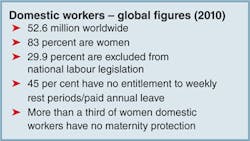
Between the mid-1990s and 2010, there was an increase of more than 19 million domestic workers worldwide. Many migrate to other countries to find work. It is likely that the figures contained in the report underestimate the true numbers of domestic workers worldwide. The figures also exclude child domestic workers below the age of 15, who were not included in the surveys used by the report. Their number was estimated by the ILO at 7.4 million in 2008.
“Domestic workers are frequently expected to work longer hours than other workers and in many countries do not have the same rights to weekly rest that are enjoyed by other workers,” said ILO Deputy Director-General Sandra Polaski.
“Combined with the lack of rights, the extreme dependency on an employer and the isolated and unprotected nature of domestic work can render them vulnerable to exploitation and abuse.”
Implementing International Standards

These new international standards are aimed at ensuring decent working conditions and pay for domestic workers worldwide. The convention has been ratified by three countries. Three other countries have completed national ratification procedures and many others have initiated them.
The findings of the research will act as a benchmark against which progress in extending legal protection will be measured, according to the ILO. The findings contribute to overcoming the invisibility of domestic workers. Domestic work represents a significant share of global wage employment, yet domestic workers remain excluded from the scope of labor laws and the legal protections afforded other workers.
Vulnerable Workers
Only 10 percent of all domestic workers are covered by general labour legislation to the same extent as other workers. More than one quarter are completely excluded from national labour legislation.
More than half of all domestic workers have no limitation on their weekly normal hours under national law, and approximately 45 percent have no entitlement to weekly rest periods. Just over half of all domestic workers are entitled to a minimum wage equivalent to that of other workers.
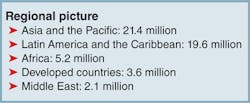
Live-in domestic workers particularly are vulnerable to exploitation since they often are paid a flat weekly or monthly rate, irrespective of hours worked. In practice, it means that a domestic worker is available whenever needed.
“The large disparities between wages and working conditions of domestic workers compared to other workers in the same country underline the need for action at the national level by governments, employers and workers to improve the working lives of these vulnerable but hard-working individuals,” stressed Polaski.
About the Author

Sandy Smith
Sandy Smith is the former content director of EHS Today, and is currently the EHSQ content & community lead at Intelex Technologies Inc. She has written about occupational safety and health and environmental issues since 1990.