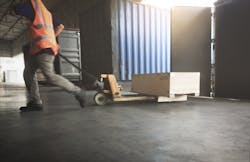
Most loading docks are not air conditioned, which increases the opportunity for excessive heat and strenuous working conditions. Dock staging areas also are expansive spaces with tall ceilings, making them hard to cool even if they are air-conditioned. Added to the challenge for any HVAC system is that dock doors frequently are opened and closed.
It especially is important to keep employees on the dock comfortable, because it's an inherently dangerous area and a fast-paced environment. A cooler dock will help employees remain alert, and studies have shown that more comfortable employees are more productive.
Fortunately, you don't have to look far to find equipment that will go a long way toward keeping employees cool, comfortable and safe during the hot summer months.
CREATING BETTER AIR MOVEMENT
High-volume/low-speed (HVLS) fans are a popular option for keeping employees cool at the dock and elsewhere in a facility. The large ceiling fans are considered a high-value, cost-effective solution to improve air movement and better overall environmental control.
HVLS fans primarily are used for cooling in spaces that are not air-conditioned and also can be used to supplement air movement in conditioned facilities. In winter, they gently move warm air near the ceiling back down toward the floor where it is needed. The air reaches the floor below the fan, where it then moves horizontally a few feet above the floor. The air eventually rises to the ceiling where it is cycled downward again. This mixing effect, called destratification, creates a much more uniform air temperature.
HVLS fans can be an alternative to traditional ceiling and industrial fans in situations where the workers are working far below a ceiling fan. High-speed floor fans can create a blast of wind for a relatively small area and can be disruptive depending on the type of work being done. Multiple floor fans also can increase the chance of mishaps involving equipment and electrical cords.
When the breeze from a fan reaches people, it creates an evaporative cooling effect and reduces the effective temperature by 10 to 12 degrees Fahrenheit. Technically, advanced HVLS fans can move large volumes of air over an area up to 22,000 square feet. A single HVLS fan can replace as many as 10 to 20 floor fans.
In air-conditioned facilities, the breeze from an HVLS fan typically allows up to a 5 degree Fahrenheit increase in thermostat setting with no change in employee comfort. That equates to an electric bill savings of 4% for each degree, resulting in an annual savings of 20%.
ALLOWING FOR VENTILATION
For facilities without air conditioning, an obvious solution for keeping employees cool is to keep the dock doors open. But open doors are not always allowed for a variety of reasons, such as security and cleanliness. It's why some companies turn to modular sectional doors with specially engineered panels to facilitate ventilation.
A modular sectional door allows users to custom-design the door to match their unique operating environment. Some can be designed with ventilation panels, which can be opened and closed with a hinged cover. The panels facilitate airflow for improved employee comfort and air quality since fresh air and light is allowed in. At the same time, unauthorized personnel, bugs and debris are kept out. The panels typically are available in a variety heights and lengths.
Doors can be outfitted with panels that can flex up to 12 inches without damage. That means they easily withstand repeated incidental bumps by forklifts and their loads, which minimizes the need to replace damaged door panels or the entire door.
Panels also can be equipped with translucent slats that allow natural light into the dock area. These slats can reduce energy costs while improving productivity and safety.
LETTING FRESH AIR IN, BUT NOT PESTS
Some facilities welcome open dock doors as long as bugs, birds and other unwanted pests and debris can't enter the facility. A simple solution that lets a large volume of fresh air enter the facility, but not pests and debris, is a screen door. The doors also can be used at large open doorways throughout a facility.
At the dock, a screen door typically mounts to the same opening as the regular dock door. Most screen doors are constructed of a heavy-duty mesh curtain that travels up and down along the side frames. On most doors, the mesh curtain collects at the top of the door on a roller mechanism. Sliding screen doors, which collect the curtain on the side of the unit, can be installed on larger openings. A variety of mounting options are available.
Since the screen door covers the entire door opening, it allows plenty of fresh air into the dock to cool employees. A screen with a bright yellow mesh also serves as a visual barrier that signals the need for pedestrians and forklifts to stay clear of the door whether it's open or closed. As a visual barrier, the screen door also can help deter vandalism and theft. When a truck needs to be serviced at the dock, or the screen door isn't needed, it easily is rolled up and stored out of the way.
PROTECTING AGAINST DOCK DROP-OFF
Whether a modular sectional door with vent panels or a screen door is used, it is critical to protect against the potential for forklifts and people to fall off of the dock. This potentially catastrophic safety issue is known as “dock drop-off.” The accident typically involves a 4-foot drop to the ground outside the raised dock platform and it can happen when a dock door is open or closed.
Safety-minded companies often use dock barriers and gates in place of a single chain across the dock door to protect against dock drop-off. The use of a chain is an outdated practice since it offers minimal, if any, protection when materials handling equipment is involved in a dock drop-off incident.
Many companies look to fabric dock barriers to guard against the risk because of their adaptability and ease of use. A fabric dock barrier typically consists of a highly visible mesh curtain that spans the dock door opening. The curtain, which often is reinforced with restraint straps, manually connects to steel guards mounted on each side of the door.
Heavy-duty barriers can stop a 10,000-pound forklift traveling up to 4 mph. Light-duty models, meanwhile, typically are designed to prevent pedestrians, carts and non-motorized lift trucks from falling off the dock.
Safety gates offer yet another option for protection at the dock, as well as other locations throughout virtually any industrial facility. Heavy-duty gates are designed to stop a forklift, while light-duty gates provide protection against incidental materials handling impacts.
STRIKING THE RIGHT BALANCE
Keeping employees cool at the dock should be part of any effort to help prevent heat stress. However, employers need to pay close attention to overall safety of the dock as they strive to create a comfortable working environment.
The bottom line is to strike a balance between comfort and safety.
Andy Olson is the marketing manager for Rite-Hite Corp.