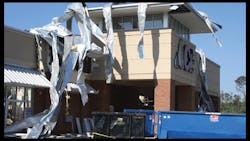
We called it the Flood of ’95. A 36-inch pressurized water main fractured under the pavement in front of our office building on Jan. 28, 1995. The pressure from the rushing water blew a large hole in the street and blew huge chunks of concrete through the windows of the building.
A mini tsunami, carrying an estimated 6 million gallons of water, then poured through the broken windows on the lower floors of the building, sending office furniture, files and computers crashing through the halls. The flood shorted out the electrical and heating systems in the lower floors, causing a second catastrophe when frozen pipes warmed a few days later and burst. We lost all of our equipment, archived materials, paper files and personal items. Virtually nothing was salvageable, because what wasn’t destroyed in the initial flood was covered in asbestos insulating material falling from the ceilings or mold by the time we were given the okay 2 weeks later to go back into the building to determine if there was anything to save.We were out of the building for a year while it was dried out,cleaned up,repaired and renovated.
“Water damage and flooding is one of the most severe disasters that can impact a facility,” says Ines Pearce, manager of the Disaster Help Desk the Business Civic Leadership Center, a nonprofit affiliate of the U.S. Chamber of Commerce.“Water damage to buildings and electronics [is bad enough],then you have mold,which becomes a second disaster.”
Water damage related to fighting fires often can be as devastating, if not more so than the fire, she adds, while earth- quakes can damage water lines and sprinklers, causing indoor floods in ad- dition to structural and equipment dam- age caused by the earthquake.
“Everyone thinks that disasters hap- pen to somebody else,” says Pearce.“But all businesses should plan for anything that might disrupt the business. It doesn’t have to be a major event like a tornado or fire or flood. It’s anything that keeps them from operating.”
Creating a Plan
The Insurance Information Institute es-timates that 40 percent of companies never reopen following a major cata-strophic event that disrupts business for any significant length of time.While that number is staggering, it isn’t surprising, given that an Ad Council survey reported that nearly two-thirds (62 percent) of re-spondents said they do not have an emer-gency plan in place for their business.
Every business needs to create a di-saster management plan that takes all possible scenarios into consideration.“It should be a living,breathing document,a process to create strategies to help you re-cover from any disaster,”counsels Pearce. “And plans have the same basic steps whether your company is large or small or has one location or many locations.”
A) Create a team to work on the plan. No one person can know every-thing about the facility or company, the supply chain, the personnel or the ven-dors and customers.
B) There is key information that needs to be located in a place – an off-site server, an off-site storage facility or “the cloud” – where it cannot be de-stroyed or damaged. This information includes full contact information for employees (including a set of secondary contact info in case the entire area is devastated and employees evacuate and scatter), full contact information for vendors and suppliers (include back-up options for vendors and suppliers, in case your emergency actually is that your largest materials supplier is shut down for some reason) and a list of the key contacts with your largest customers.
C) Know your critical operations and operators. Who are your essential personnel and what are your essential, critical functions? Have options for a back-up facility where you can divert personnel, equipment, mail and deliveries in case your facility is shut down for more than a few days or weeks.
“Businesses have to prioritize what’s critical for them,” says Pearce. “It is completely different for every business and if they don’t plan, they will be completely overwhelmed and floundering.”
Such was the case of a company that recently called Pearce at the National Disaster Help Desk for Business. The help desk provides on-the-ground coordination of information among businesses, local chambers of commerce, NGOs, government responders and disaster recovery specialists. “I asked them, ‘Have you called your insurance company?’ Their answer was ‘no,’” she says, adding, “That’s the first thing you do!”
3 Keys
Theresa Dwyer, CSP, is a former OSHA compliance officer and was an occupational safety and health coordinator for the New York Fire Department. Now, as the safety officer for a large municipality in Florida, she is prepared for just about any type of emergency, which she defines as “an unplanned event that causes death, injury or property damage.”
The key to being prepared for emergencies is to remember three things, according to Dwyer: anticipation, communication and preparation.
Anticipation – “You need to anticipate any possible emergencies that might happen to you or your community,” she says. “We get hurricanes in Florida. Maybe your company is located next to a rail line that carries shipments of hazardous materials. Maybe your business is located in a flood plain, or your area gets massive snowstorms.”
Preparation – “Get management commitment to creating a broadscope, emergency preparation plan, one that will allow you to face any potential emergency, ranging from a flood or hurricane to a fire or terrorist act,” says Dwyer. “Cross-train employees, so that if some are cut off from making it to work because of a natural disaster, other employees can fill in on essential operations.”
Dwyer also suggests that if you operate a fleet of anything – trucks, planes, rail cars, ships – that you scatter them if you get warning of a large storm heading your way, and relocate as much inventory as possible if you have notice of a hurricane or potential flooding conditions.
She also keeps a supply of potable water, electrolyte drinks, canned food and energy bars on hand, just in case employees are called in to work as essential personnel or can’t make it home because of weather conditions and have to weather a storm at work. “Breakfast, lunch, protected shelter… anything they need to provide them with nourishment, give them the opportunity to call their families and help them relax for a while so that they can gear up and get back in there.”
She also suggests that if employees essential to operations must be at work during a community-wide emergency, that other employees be designated to check on their families and see if anything is needed until they can return home. “They will remember you looked out for them and their families and thank you when the emergency is over,” says Dwyer.
About the Author

Sandy Smith
Sandy Smith is the former content director of EHS Today, and is currently the EHSQ content & community lead at Intelex Technologies Inc. She has written about occupational safety and health and environmental issues since 1990.